
Mr. Denis “Gus” Clement Gaskin
Mr. Denis Clement Gaskin (Gus) was born in Georgetown, British Guiana in 1898. At the young age of 16, he travelled to Canada.
He fudged his age in order to join the Canadian army. While stationed overseas, he met and married Helen Margaret MacDonald.
They returned to Canada in 1919, settling in Montreal. After realizing he could not raise a family on the salary offered from the
Royal Bank of Canada ($25.00 a week), he accepted a position with REO (Ransom E Olds for $30.00 a week), founder of Oldsmobile
manufactured in Lansing, Michigan. Gaskin moved his family to Windsor, Ontario where he handled customs and duties. After resettling,
he was invited to work directly under Mr. Olds in the Accounting Department in Lansing. In 1927, Denis was transferred to Houston, Texas,
where he moved with his wife and three young sons (Ron, Vic and Neil). There, he handled the distribution of sales of REO products.
At that time, the auto industry was a wealthy one. Life was good until the stock market crash of October 29th, 1929.
As the Great Depression took its toll, REO decided to get out of the car business and concentrate on building trucks. Gus was forced to look
for work. The family moved their belongings back to Windsor, Ontario and lived in a downtown Detroit hotel during his search. He landed
a job with Studebaker. The Hossierland automaker needed someone in their Canadian operations in Walkerville, Ontario (amalgamated
into the City of Windsor in 1935). The Canadian Studebaker plant opened in 1910 when E-M-F (a company closely associated with Studebaker)
bought the Globe Furniture Company and converted to automobile production. Cars assembled in Canada got preferential tariff breaks
throughout the British Empire. Exports were substantial. Gus Gaskin started at Studebaker as Assistant Sales Manager; but prior to receiving
his first paycheque salaries were cut by 10%. Gaskin was innovative. He insisted that he drive the product he was promoting. When city folk
no longer had money, he traded in his company car and drove a company truck. Farmers could still buy trucks! With the introduction of the
very popular Studebaker Champion in 1939, production was again viable in Canada; but when World War II broke out in the fall, plans for
reactivating the Canadian Assembly Plant were shelved until the war’s end.
In 1941, at the age of 43, Gaskin was named Vice-President and General Manager of Studebaker. Studebaker was a principal player in
building the Alaskan Highway during WW II. Gaskin set up a parts distribution system to keep trucks moving over the rough terrain.
Gus Gaskin was a well-known figure throughout the country. His presence filled a room and his parties were legendary. Gaskin’s flair
for dressing often gave him status on the list of top ten best dressed men in Canada. As the war began to wind down, Gaskin saw a
golden opportunity for acquiring a new factory and succeeded in purchasing a very modern factory in Hamilton for only $500,000.00.
The 320,000 square foot facility was built by Otis Elevator for the manufacture of ammunition. Part of the land was owned by the
Canadian National Railway, so a three way deal was worked out. Champions started to roll off the line and out Hamilton’s doors in August 1948.

Vice President Gus Gaskin showing off the new 1950 Studebakers to RCAF Officers as they get off the Assembly Line
By 1951, production and sales had risen steadily and the top of the line Commander joined the list of domestically made Studebakers.
The plant was highly profitable. In 1952, after being in charge of Studebaker’s Canadian operation for many years, the Board of Directors
conferred the title of President on Gus Gaskin. He would report directly to World Chairman, Howard Nance. Winds of change blew
through the post-war industry.
In 1954, Nash merged with Hudson while Packard bought Studebaker. The Studebaker - Packard merger had serious ramifications
in Canada for Packard. The only person hired from Packard was the National Service Manager. The company’s name was changed
to Studebaker-Packard of Canada. Limited to reflect the acquisition but Packards continued to be exported and little changed in Hamilton
as a result of the merger. Packard did not sell many cars but the company was solidly in the black. Packards sold for big bucks, the profit
margin was high and the product was highly respected. Movie stars and glamour people bought Packards and President Gus Gaskin
drove the biggest Packard available.
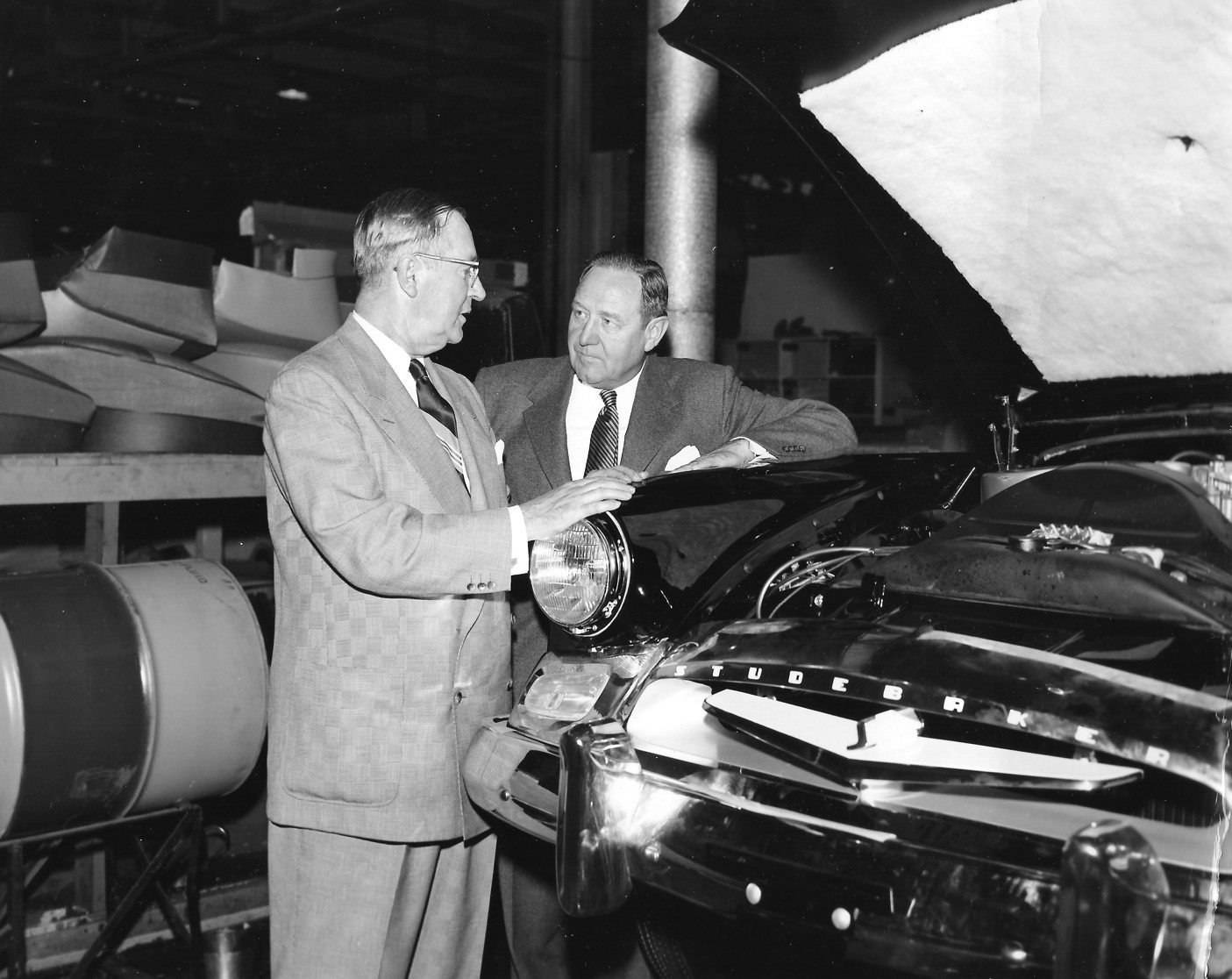
President Gus Gaskin looking over the new 1955 Studebakers prior to shipment
With Studebaker in the fold, Nance decided to broaden the corporate line up. It would be a costly venture and many were against it.
The new team was an uneasy mix. Gaskin and his Canadian team had been buddies for a quarter of a century. Nance’s team had all
been low-level management prior to coming to Studebaker. Nance made sure the old time Studebaker people had no say in decision
making. When the bottom-of the-line Studebaker Scotsman was released to the team in the spring of 1956, the old time Studebaker
people were aghast at how the whole car had been stripped down and cheapened to save money, to the point they felt it unworthy
of the Studebaker name. Never one to mince words, when Gus was asked what he thought of the new Studebaker Scotsman, his
response was, “maybe it would help if we took the damn wheels off the car”. The meeting broke up shortly thereafter. Nance was
fired when he lost the confidence of the company's backers. The Canadian subsidiary was still profitable, but the product line
grew thinner. Studebaker-Packard’s days were numbered.
Gus left Studebaker at the end of December 1958. He became the president of Mack Truck in Canada and remained in that position
until the time he died. Denis Clement Gaskin (Gus) died at the age of 62, in September 1960. He was predeceased by his son, Ron
who was killed in action in World War II. At the time, he was survived by his wife Helen and their two sons Victor and Neil,
daughters-in-law Marie (Ron) and Eleanor (Neil) as well as their six grandchildren. He was a veritable force in the automotive
industry for forty-one years and made his presence known wherever he went. Although he had a big voice and usually had a
lot to say, his mere presence made a statement. He has left quite a legacy to all who knew him, worked with him and loved him.
Written by the Gaskin Family with assistance from:
Extracts taken from Autobiography – Industry Profile written by Mr. James Mays.
Denis (Gus) Gaskin Four decades of Automaking – Published in Old Autos in 2002

Studebaker Made in Canada