
Mr. William "Bill" Moeser
Studebaker Corporation Vice President Manufacturing - Hamilton Plant
William "Bill" Moeser was born in 1921 in Toronto, Ontario Canada, the youngest of four children. His father had left school at age 12 to earn a living, eventually becoming a skilled machinist
and later a successful business-leader. Bill’s mother was a full-time homemaker. By the time Bill was born, the family had built a comfortable life in Toronto. Bill displayed an
early fascination for engines, machinery and their design. As a teenager he and his brother Ted bought a Ford Model T which they fixed up and drove around Toronto in the late 1930s.
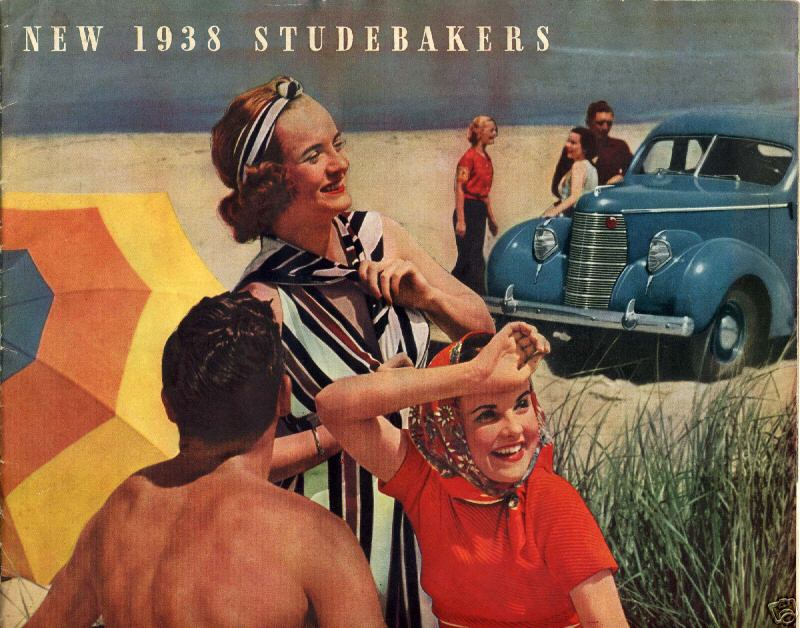
In 1938 Bill had his first experience with a Studebaker. At the CNE Automotive Pavilion in Toronto he and his father saw a 1938 Metallic Silver Grey Studebaker President "8" on the display dais.
In Bill's own words “It had wide whitewall tires, beautiful broadcloth upholstery, overdrive with automatic clutch, free-wheeling and nearly 17 ft long on a 120-inch wheelbase. It was a luxury car comparable
to GMs LaSalle V8, Buick 8, Lincoln Zephyr V12, Packard 120 and Chrysler Imperial." It proved to be so attractive that Bill's father bought the car on the spot, and it was a family fixture for the next 3 years.
In September of 1939 Bill entered the University of Toronto in Mechanical Engineering, just as WWII broke out. The military desperately needed engineers so he and his classmates
were enrolled in the combined-forces Officer Training program, in parallel with their studies. Bill had designated the Navy as his first choice. As a result, by early 1943
he was Engineering Sub-Lieutenant on HMS Ettrick (later transferred to the Royal Canadian Navy as HMCS Ettrick), on convoy duty between Halifax and the British Isles... back and forth,
constantly hoping his ship wasn't going to be one of those sunk by a U-boat. On a shore-leave in February 1944, he took the train back to Toronto to marry May Lindsay, his high-school sweetheart;
then they got on the train and headed back to Halifax. His final assignment was on HMCS Westmount, a minesweeper which did the Boston - Halifax - St Johns Triangle, escorting convoys
until they would be passed on to other escorts for the remainder of the trip to the United Kingdom.
 HMS/HMCS Ettrick, a Frigate which was assigned Convoy duties in 1943 |
 Sub - Lt Bill Moeser, RCN in 1943 |
 HMCS Westmount, a Minesweeper which escorted Merchant Ships on the Boston-Halifax-St. Johns Triangle |
After the war, in 1945 Bill was immediately recruited by Massey-Harris as a manufacturing engineer in Toronto. By 1952 Massey-Harris had sent him (and the family… by then
Bill and May had two children) to their new factory in Lille, France, as plant manager. Then in 1955 (now with three children) they were moved to Melbourne, Australia, where Bill
became manufacturing manager and helped integrate the Ferguson Tractor operations with Massey-Harris. In 1961, he was moved back to the Massey-Ferguson headquarters in Toronto.
These are in the words of his son, Doug Moeser about his father's Studebaker Experience
"In 1962 he left Massey-Ferguson to take the job as Plant Manager at Studebaker in Hamilton. I remember he was like a kid given the keys to a chocolate factory: my Dad was a car guy;
he had always loved cars. He loved the mechanical details, he loved a car that handled well; he also loved the latest trends in design and styling, the latest automotive feature or gimmick or
advertising slogan. Most of all, he simply loved to drive. (He taught me to drive. Properly: with a manual transmission. I remember him explaining that it's more fun to drive a slow car
quickly than to drive a fast car slowly.) So finally, after 17 years building tractors and combine harvesters, he was now going to actually get to build cars! I think those years at Studebaker
were very happy ones for him despite the fact it was a slowly sinking ship

President Gordon E Grundy shaking the hand of Vice President Bill Moeser in celebration of
sending out the first patch of Canadian Built Studebakers for worldwide distribution
I was only 11 when he moved to Studebaker, but I certainly have memories of Dad's years there: his Company car was a black Gran Turismo Hawk, but he often
drove home from work in a constant stream of new Larks ('test driving' cars right off the end of the assembly line, I think), or a Wagonaire, occasionally another Hawk,
once or twice an Avanti. Once, he arrived home in an Isuzu Bellett.. the first Japanese car I've ever seen. As he and I pored over, under and into the Isuzu he told
me about the astounding quality control of their manufacturing, and the idea of a possible joint venture between Studebaker and Isuzu in Canada.
My Dad was passionate about the idea that Studebaker could survive in Hamilton and become "Canada's Own Car". (He really liked that slogan: no doubt because during our years
living in Melbourne, GM's Holden brand was relentlessly advertised as "Australia's Own Car.”) After the Studebaker dream ended, he worked at Ford in Oakville for a year or so.
Then he went to General Spring company (automotive seating) in Kitchener, Ontario, as it was being absorbed by Lear-Siegler, a much-larger US company. He spent the remaining
two decades of his career as President of Lear-Siegler Canada, a major supplier to Ford and GM. Throughout his life my dad had an uncanny way of connecting with people from all kinds
of backgrounds, and as a result, he had an incredibly broad network of friends worldwide. He could walk into a room anywhere, strike up a conversation with someone at random and
within minutes had identified some common interest or connection... had made a new friend. More often than not, these connections involved cars. Even into his 80s, whenever I'd come to
visit him (often I'd rent a car at YYZ and drive up to Kitchener) his first words when we met would be "What are you driving today?"... which would then turn into a discussion of the
pros and cons of that vehicle, what else I'd driven recently, and what we each thought of any other new or interesting cars or vehicle technologies. Yes, he was definitely a car guy.
And Bill’s daughter Lindsay recalls:
After returning from Australia and then living for a year in Toronto, we moved on to Ancaster in 1962 when Dad took his position at Studebaker. My memories may be a
little vague as I was only seven years old in ’62, but I remember he was very excited about our move: we were to drive “up the mountain” on an old winding highway to reach
our new home. Over the next few years Dad would often would take me out for a weekend drive. I realize now part of this was to demonstrate how his car (one of many Studebakers)
could handle the “hair-pin turns” of Ontario’s Niagara Escarpment (the “mountain”)! It truly was as exciting for me as was our main mission those days (at least for me)
which was to hike the famous Bruce Trail near our new home in Ancaster. I am not a “car nut” but I do still occasionally impress my friends (and even my husband John) with auto identification.
And I also love to drive a nice car, although my bicycle is still preferred.
In 2021 Bill was recognized as a Studebaker Made in Canada Honouree for his outstanding contributions to Studebaker of Canada and his attempts to keep the dream alive
of producing Canada's Own Car during his tenure as the Hamilton Plant Vice President of Manufacturing. Many thanks goes out to Bill's son Doug
and his daughter Lindsay for their contributions in developing this Biography

Studebaker Made in Canada